
Every few months, a new AI demo appears showing a single agent capable of doing everything. It can search the web, write code, analyze documents, answer emails, generate reports, and execute workflows—all from one prompt. The vision is compelling: one intelligent assistant that understands every request and handles every task.
For simple use cases, that approach often works well. Modern large language models are remarkably capable generalists, able to reason across domains and perform a wide variety of tasks with minimal instruction.
But as organizations begin deploying AI into production, a different pattern is emerging. The most reliable AI systems are rarely built around one all-knowing agent. Instead, they consist of multiple specialized agents working together, each responsible for a specific role within a larger workflow. Just as modern software evolved from monolithic applications to distributed services, successful AI systems are evolving toward distributed intelligence.
The challenge is no longer building smarter agents. It is designing how agents collaborate.
Why Bigger Isn’t Always Better
The instinct to create one powerful agent is understandable. Large language models can write code, answer customer questions, analyze financial reports, generate marketing copy, and interact with software through APIs. If one model can perform all these tasks, why not give it access to every tool and every responsibility?
The problem is that intelligence alone does not eliminate complexity. Every additional responsibility increases the number of instructions an agent must follow, the tools it must choose between, the business rules it must respect, and the possible outcomes it must evaluate. An agent that writes SQL queries, summarizes contracts, books meetings, validates invoices, and manages customer support conversations constantly shifts between unrelated contexts. As those responsibilities accumulate, prompts become larger, tool selection becomes less reliable, and behavior becomes harder to predict.
Software engineering has already learned this lesson. Over the past two decades, many organizations moved away from monolithic architectures toward smaller services with clearly defined responsibilities. AI systems are beginning to follow the same path. Rather than building one enormous agent that attempts to solve every problem, organizations are building ecosystems of specialized agents that excel within carefully defined boundaries.
Specialized Agents Produce Better Systems
A specialized agent is designed to perform one category of work exceptionally well. Rather than understanding every business process, it receives instructions, tools, and context tailored to a specific responsibility.
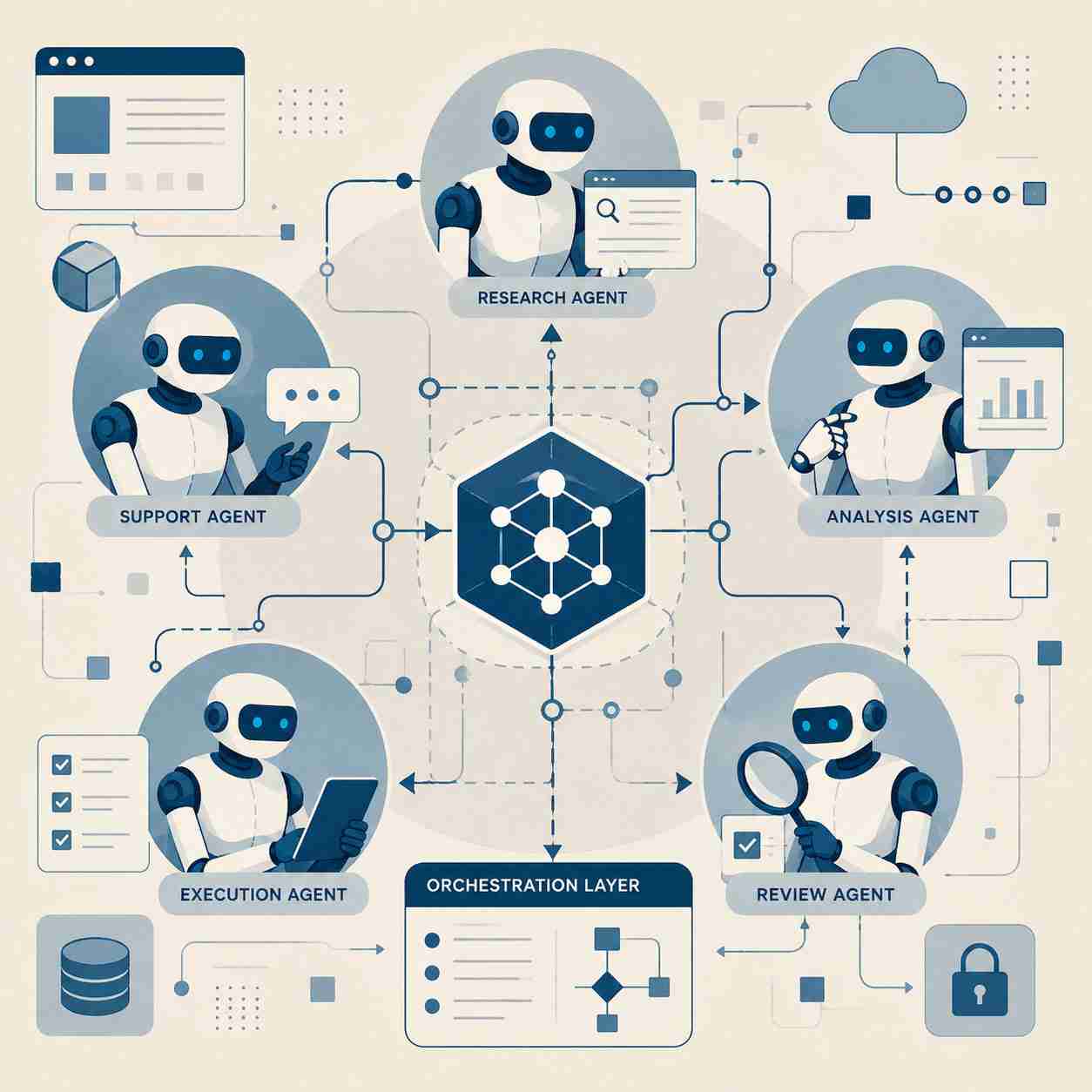
A customer support agent retrieves account information and drafts responses. A research agent gathers information from documentation and external sources. A planning agent breaks complex objectives into manageable tasks, while an execution agent interacts with APIs to update business systems. A reviewer agent evaluates outputs for quality, policy compliance, or factual consistency before anything reaches an end user.
Keeping responsibilities narrow produces important engineering benefits. Prompts become easier to maintain, tool selection becomes more reliable, and testing becomes significantly simpler because each component performs one job instead of dozens. When problems occur, engineers can isolate the source much more quickly than they could within a single all-purpose agent.
Most importantly, specialization improves reliability. Just as organizations employ accountants, designers, lawyers, and engineers rather than expecting one employee to master every profession, AI systems benefit when individual agents develop expertise within clearly defined domains.
Orchestration Is Where the Real Engineering Happens
Once multiple agents exist, another challenge appears: deciding how they work together. This responsibility belongs to the orchestration layer, which often becomes the most important part of the system.
Orchestration determines which agent receives a task, what information it receives, when additional agents should become involved, and how the workflow progresses from beginning to end. It manages dependencies, coordinates parallel execution, handles failures, and determines when human approval should interrupt an automated process.
Although language models perform the reasoning, orchestration provides the structure that transforms isolated AI capabilities into a functioning application. In many enterprise systems, this layer contains more deterministic software than AI. Business rules, retry logic, security checks, logging, approval workflows, and state management are all implemented using conventional software engineering techniques.
This surprises many teams entering AI development. The language model may be the most visible component, but the surrounding architecture ultimately determines whether the system behaves consistently in production.
Routing: Finding the Right Expert
One of the most common orchestration patterns is routing. Instead of allowing every request to reach every available agent, the system first determines which specialist should handle it.
A request asking about invoice payments belongs to a finance agent, not a software engineering assistant. A legal contract should be analyzed by an agent configured with legal guidance rather than a general-purpose chatbot.
Routing decisions can rely on deterministic rules, lightweight AI classifiers, or even supervisory agents that dynamically choose the appropriate specialist based on user intent, available tools, permissions, and confidence levels.
Effective routing improves both efficiency and quality. Specialized agents spend their time solving problems they understand well instead of attempting to interpret requests outside their expertise.
Delegation: Breaking Problems into Smaller Tasks
Many business workflows cannot be completed by a single agent because they involve multiple independent activities. Delegation allows one agent—or the orchestration layer—to divide a complex objective into smaller tasks and distribute them among specialists.
Consider an executive requesting a competitive market analysis. Rather than asking one agent to perform every step, the system can assign research to one agent, financial analysis to another, news collection to a third, and visualization generation to a fourth. Once those tasks are complete, a reporting agent assembles the final presentation.
No individual agent understands the entire workflow. Each contributes a specialized capability while orchestration ensures the pieces fit together.
This mirrors how successful organizations operate. Managers rarely perform every task themselves. Instead, they coordinate specialists whose combined expertise produces better results than any individual could achieve alone.
Arbitration: Handling Disagreement
Multiple agents do not always reach the same conclusion. One agent may classify a transaction as suspicious, another may assign it a low-risk score, while a third concludes there is insufficient information to make a reliable decision.
Production systems need explicit mechanisms for resolving these disagreements.
Sometimes deterministic business rules determine which result should prevail. In other situations, confidence scores, historical performance, or additional validation steps influence the final outcome. In high-risk domains such as healthcare, finance, or legal services, disagreement between agents often triggers mandatory human review.
This is one of the defining characteristics of enterprise AI. Mature systems do not assume models are always correct. Instead, they acknowledge uncertainty and build processes for managing it safely.
Context Should Flow Intentionally
Another common misconception is that every agent should have access to every piece of information. In reality, excessive context often hurts performance.
Most specialized agents need only the information relevant to the task they are performing. A scheduling agent rarely benefits from reading legal contracts, and a billing assistant does not need product roadmap discussions. Providing unnecessary context increases token usage, introduces distractions, and can reduce reasoning quality.
Successful multi-agent systems therefore treat context as a resource that flows intentionally through the architecture. Shared state exists where collaboration requires it, while task-specific information remains isolated. Knowledge is retrieved on demand instead of included by default, producing systems that are both more efficient and easier to maintain.
When Multi-Agent Systems Become Too Complex
Despite their advantages, multi-agent architectures are not automatically the right answer. Many teams introduce multiple agents simply because the concept is popular, even when a single well-designed agent would solve the problem more effectively.
Every additional agent increases orchestration complexity, testing requirements, debugging effort, latency, and operational cost. Communication between agents creates additional failure points, while maintaining shared state becomes progressively more difficult as workflows expand.
A customer support assistant connected to a retrieval system may perform perfectly well as a single agent. Splitting that workflow into several collaborating agents may add complexity without delivering meaningful benefits.
The decision to introduce another agent should therefore be driven by responsibility rather than capability. If two parts of the workflow require different tools, permissions, or evaluation criteria, separating them often improves maintainability. If they perform essentially the same work, another agent may simply add overhead.
Anthropic’s guide to building effective AI agents.
The Future Belongs to Well-Designed Systems
Much of today’s AI conversation focuses on increasingly capable models. Yet production deployments consistently show that model quality is only one part of the equation.
As language models continue to improve, competitive advantage will increasingly shift toward system design. Organizations will differentiate themselves not by owning a better model, but by building architectures that coordinate intelligence effectively, manage context efficiently, enforce governance, and integrate seamlessly with existing business processes.
Multi-agent systems represent an important step in that evolution. Their value does not come from multiplying intelligence but from organizing it. Just as software engineering evolved from monoliths to distributed systems, AI engineering is evolving from isolated assistants to coordinated networks of specialized agents.
The hidden architecture behind those systems—the orchestration layer, routing logic, delegation patterns, arbitration mechanisms, and governance rules—is what ultimately determines whether AI succeeds outside the demo environment. As models become increasingly commoditized, designing those systems will become one of the defining engineering disciplines of the AI era.
