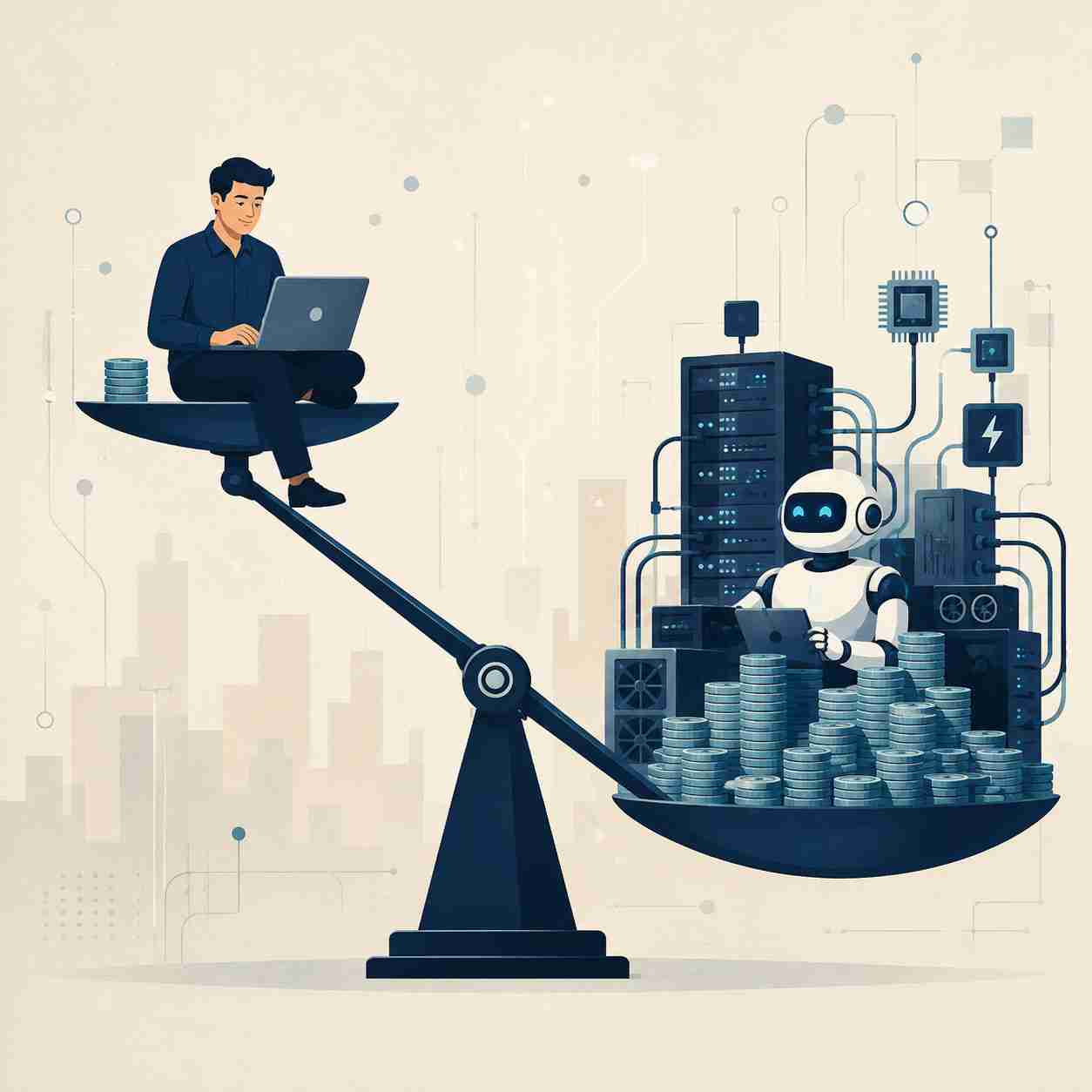

For the past few years, the economic argument for AI has sounded almost self-evident: software can perform more work, faster and at a lower cost than people. If an AI coding agent can generate a feature in hours, why pay a developer to spend days on it? If an automated support agent can handle thousands of conversations, why expand the team?
That logic is directionally useful, but financially incomplete.
AI can make an individual task cheaper while making the system around it more expensive. Agents consume tokens as they load context, call tools, retry failures, and generate outputs that still need evaluation. Add integration, monitoring, security, testing, and human supervision, and the cost no longer looks like a simple software subscription.
In some environments, the AI bill may eventually exceed the cost of the developers it was expected to replace. That does not mean AI has failed. It means companies need a better way to calculate its value.
The Price of AI Is No Longer Just a Seat
Most businesses first encountered generative AI as a predictable monthly expense: a few chatbot licenses small enough to disappear inside the software budget.
That is still how many organizations use AI. According to Ramp’s June 2026 AI Index, the median company in its dataset spent just $11.38 per employee per month on AI. But the top 1% spent $7,449 per employee per month—almost $89,400 per year. Those firms also increased their spending per employee by 14.1% in a single month. The difference between experimentation and intensive adoption is already enormous.
The change comes from moving beyond chat. An agentic system can plan a task, search sources, call APIs, run tests, inspect failures, and repeat the cycle. One visible action can become hundreds of model interactions behind the scenes.
This is why “cost per seat” is becoming the wrong metric. Businesses must also consider cost per workflow, cost per successful outcome, and cost per exception that requires a person to intervene.
Cheap Tokens Do Not Guarantee Cheap Systems
Model prices continue to fall, while smaller and open-weight models can handle many tasks at a fraction of the price of frontier systems.
But lower unit prices do not automatically reduce the total bill. When something becomes cheaper and more useful, people often use much more of it. Faster models encourage teams to run more agents. Larger context windows encourage applications to send more data. Better reasoning models make it possible to automate longer and more complicated processes.
A coding agent may read an entire repository, generate alternatives, run a test suite, and ask another model to review the result. Even when every token is cheaper, total consumption can grow faster than prices fall.
This creates a familiar cloud-computing problem: the individual resource looks inexpensive, but usage scales invisibly. Without budgets and observability, the monthly invoice is where the architecture reveals itself.
The Hidden Costs Sit Around the Model
The API bill is only the most visible part of AI spending. Production systems also require software and people around the model.
Data must be cleaned, permissioned, and kept current. Models need reliable integrations. Outputs must be checked when errors could affect customers, payments, compliance, or operations. Teams need logs, while security controls must limit what the model can see and do.
Then there is rework. Code that appears functional may duplicate existing logic, expose data, or create maintenance work elsewhere. If a developer spends hours reconstructing the model’s assumptions, the apparent saving can disappear.
The same problem appears outside engineering. A service agent may resolve routine questions cheaply but mishandle unusual cases. A document system may achieve impressive accuracy yet still require people to review high-risk exceptions.
AI is not expensive only when it consumes many tokens. It becomes expensive when the organization cannot trust its output without rebuilding the work around it.
Comparing AI With a Developer Is the Wrong Equation
A developer and an AI system are not interchangeable cost categories. Developers clarify requirements, identify tradeoffs, understand existing systems, decide what should not be built, and take responsibility for outcomes. AI accelerates parts of that work but does not assume ownership of the result.
Productivity gains also do not always become headcount savings. A team may ship more with the same developers rather than maintain its output with fewer people. The return then comes from capacity, faster learning, or new revenue—not payroll reduction.
Frontier AI companies make this distinction especially visible. Tomasz Tunguz estimated that Anthropic’s compute spending could equal roughly 2.3 times its payroll. At the same time, Epoch AI estimates that Anthropic and OpenAI generate approximately $14 million and $6.5 million in annualized revenue per employee, respectively. Their infrastructure is extraordinarily expensive, but it supports an equally unusual revenue model.
Most companies do not have those economics. Copying an AI lab’s spending without its scale or revenue would be dangerous. The question is whether the complete system creates more measurable value than it consumes.
Where AI Spending Gets Out of Control
Expensive AI implementations often use the largest model for every task, allow unlimited retries, repeatedly send oversized contexts, and automate poorly understood processes. They measure activity—prompts, generated code, conversations—rather than successful outcomes.
These systems look productive because they are always doing something. But an agent that completes ten steps before creating an error is worse than a deterministic process that succeeds in one.
Cost control starts with architecture. Simple tasks should use simple models or conventional software. Information should be cached. Model calls need budgets, timeouts, and stopping conditions. High-risk actions require approval. Workflows need a baseline such as human labor or existing automation.
The goal is not to minimize AI usage. It is to spend intelligence where intelligence matters.
Build for Unit Economics, Not Demonstrations
A prototype proves that a model can perform a task. Production must prove it can do so reliably and at an acceptable cost.
That requires measuring the full unit economics. What does one successful support resolution cost? How many engineering hours does a coding agent save after testing and corrections? What happens when usage grows tenfold?
These questions change the design. A business may reserve a frontier model for ambiguous cases, replace part of an agentic workflow with deterministic code, or request human approval at one critical point rather than review every output later.
The companies that benefit most from AI will not necessarily be those that use the most tokens. They will be those that understand where models create leverage, where traditional software is more dependable, and where human judgment remains more valuable than another automated step.
AI can cost more than hiring developers. It can also create far more value than its cost. Both statements can be true. The difference lies in what the company builds around the model—and whether anyone is measuring the result.
Zarego helps businesses turn promising AI ideas into reliable products with sustainable economics. Our teams combine AI-assisted engineering, software architecture, integrations, security, and product thinking to design systems that use the right model for each task, control unnecessary consumption, and keep people involved where judgment matters. If you are evaluating an AI product or trying to understand why an existing implementation is becoming more expensive, we can help you build a solution whose business value grows faster than its compute bill.
Let’s talk.
